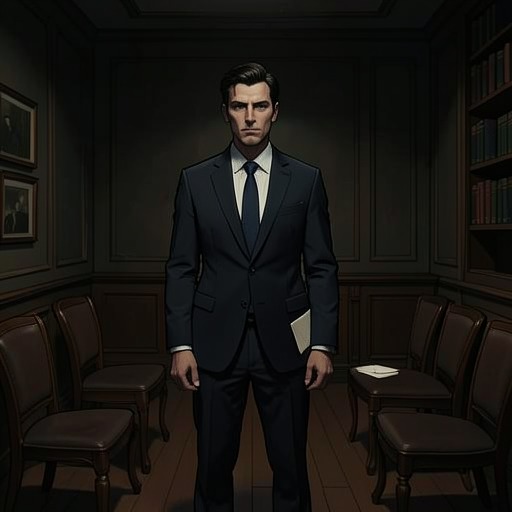
Takaki looks back after passing a woman at the railroad crossing
5 Centimeters per SecondTakaki looks back after passing a woman at the railroad crossing in a brief encounter that gathers the past into a single spring moment, then turns its force toward a decision to keep moving. A drift of cherry blossoms, the crossing alarm, a stranger’s footsteps, and the sudden screen of an express train make the scene less a reunion than a test of what Takaki will do with hope when certainty remains out of reach.
Setting and Approach
After leaving his company job, Takaki walks through residential neighborhoods and notices the city with a freshness he had lost: the smells of morning, evening, starry nights, and cloudy skies, mixed from people, the city, and nature. He buys coffee from a vending machine, drinks it in a park, watches schoolchildren pass, and looks from a pedestrian bridge toward the skyscrapers of Shinjuku. The scene places him in ordinary public space, among the movement of a city that has continued without him, while his unhurried walk gives attention to details previously overlooked.
At the crossing, a large cherry tree stands over asphalt whitened by fallen blossoms. Takaki watches petals descend and thinks, “That’s five centimeters per second.” The thought links this particular spring sight to a recurring image of slow movement and distance. It arrives without ceremony, as a measure supplied by memory before the woman appears; the past is already active in the present landscape.
The Encounter
The crossing alarm starts ringing, and a woman approaches from ahead. The click of her white mules joins the alarm’s rhythm as they pass at the center of the crossing. The meeting itself is fleeting and wordless: neither speaks, and the scene offers no exchange that could settle who she is or what she knows. Yet Takaki feels a faint light flicker in his heart as they continue in opposite directions.
He becomes convinced that if he turns around, she will turn around too, though he has no reason to trust that expectation. Its importance lies in the force with which he believes it, not in any evidence that the woman recognizes him. He turns slowly after crossing; she also turns slowly, and their eyes meet. The moment produces a powerful stirring in his heart and memories, making the encounter feel consequential while leaving its meaning unresolved. The woman is not definitively identified, and the scene does not confirm that she is the person Takaki hopes she might be.
Interruption and Decision
An Odakyu Line express train passes between them and hides the woman from Takaki. Its arrival cuts off the instant of mutual recognition before either person can act on it. The train converts the crossing’s ordinary division—one direction of travel separated from another—into a sharp uncertainty: Takaki cannot know whether she will still be there when the barrier between them is gone.
He considers the possibility that she may not be waiting, then decides that the encounter would already be a miracle if she really was the person he imagines. That thought loosens the scene from its demand for proof. Instead of making his next step depend on receiving confirmation, he makes up his mind that when the train passes, he will start moving forward. The decision is modest and immediate, not a promised reunion or a declaration that the past has ceased to matter. Its change is from waiting for an answer to choosing an action despite not knowing what the answer will be.
Significance
The scene holds recognition and separation together. For an instant, the woman turns back and meets Takaki’s gaze; then the train removes her from view. The chance of connection is neither fulfilled nor explicitly denied, and the narrative preserves that uncertainty rather than naming the stranger or supplying a conversation. What changes is Takaki’s response to uncertainty: he can accept the encounter as meaningful without requiring it to restore what has been lost.
The falling blossoms and the remembered speed in Takaki’s thought set a slow, measured image against the crossing’s alarm and the express train’s abrupt passage. Their contrast gives the scene its movement: memory returns, a possible recognition intensifies it, and an interruption prevents certainty. Takaki’s final resolve does not erase the stirring in his heart; it gives that feeling a different consequence. Instead of remaining fixed on whether the woman is still there, he chooses to move forward when the train has passed.